

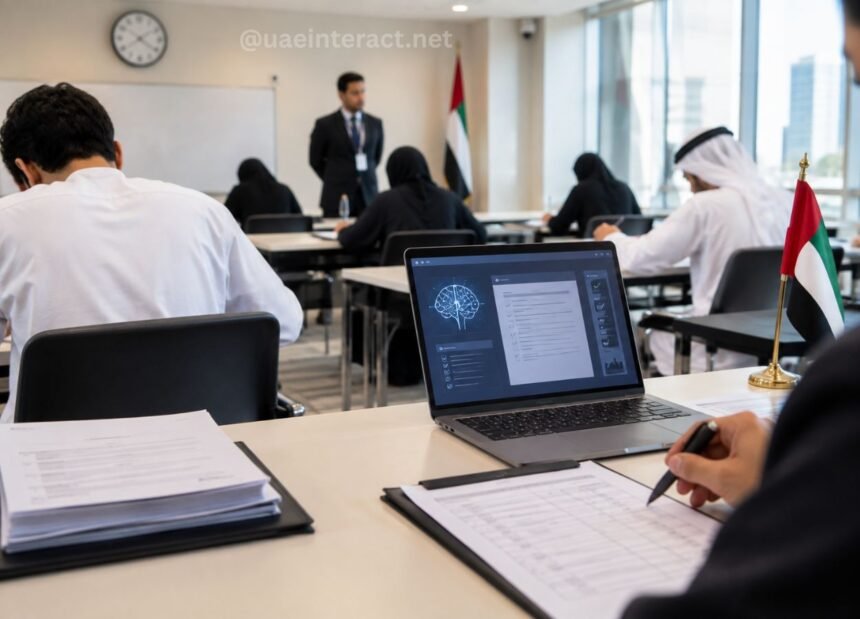
Universities in the UAE that deliberately soften assessments to help students pass could now face regulatory penalties, the country’s top academic accreditation official has warned, as a sweeping new violations framework takes effect this week. UAE Exam Integrity
Prof Amjad Qandil, Director of the Commission of Academic Accreditation for Higher Education, told a Ministry of Higher Education forum in Abu Dhabi on Wednesday that assessments intentionally engineered to be easy to pass constitute a serious breach under Cabinet Resolution No. 143 of 2026 — even though many institutions may not currently view the practice as problematic.
The resolution comes into force on September 12 and consolidates rules covering licensing, data accuracy, academic integrity, examination security and advertising across universities, technical colleges and training centres.
The framework applies a tiered penalty system based on how severe or repeated a violation is, with fines reaching up to Dh500,000 alongside measures that can restrict admissions, licensing or accreditation.

For academic-integrity breaches specifically, institutions found to have weak oversight of exam security or a pattern of enabling cheating face escalating consequences — including, after a third repeat offence, potential revocation of their licence or accreditation, though student protections and fee refunds remain mandatory throughout.
Ahmed Al Hammadi, the Ministry’s Director of Legal Affairs, said the system is built around early correction rather than punishment, giving institutions a chance to fix problems before facing harsher action. Institutions can contest rulings through a written grievance within 60 days, though this does not automatically pause enforcement.
The forum also tackled how universities should handle artificial intelligence in coursework. Rather than policing AI use, Prof Qandil argued institutions must redesign assessments to remain valid despite easy access to such tools, describing the goal as building “AI-resilient” exams instead of chasing detection.
Abu Dhabi University offered a practical example of this shift already under way. Vice Chancellor of AI Hamad Odhabi said the institution moved away from single-submission assignments toward staged assessments requiring students to present plans, defend their reasoning and build prototypes under faculty supervision.
An AI-based exam moderation tool has reviewed more than 2,400 exams since launching roughly a year ago, checking their quality and alignment with learning outcomes. UAE Interact