
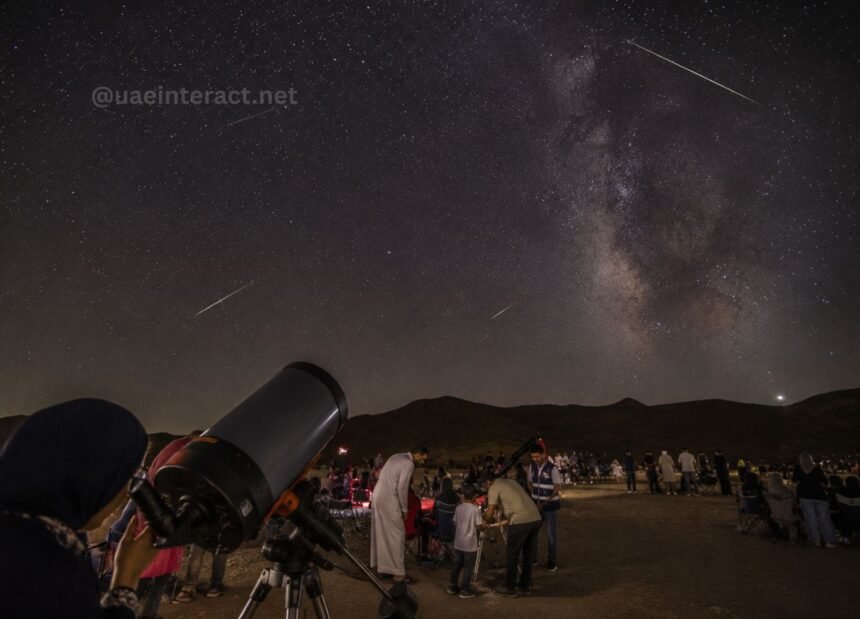
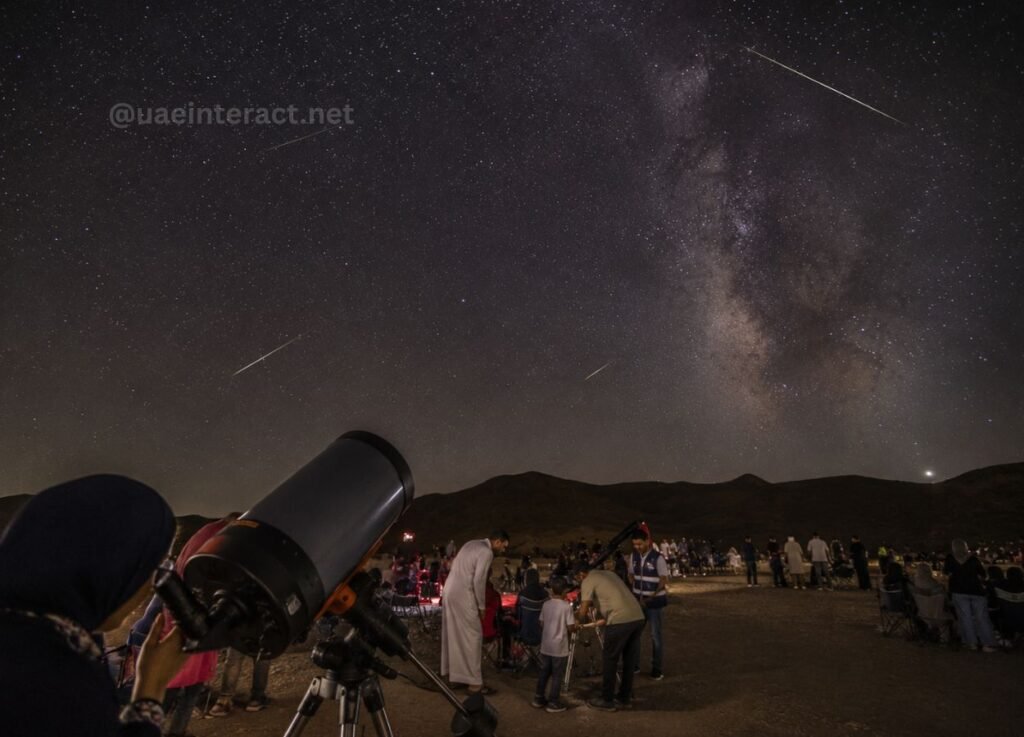
Hundreds of people who look at the stars, local people and those who love astronomy came together in the protected dunes of Mleiha National Park during the night. They watched the peak of the Perseid meteor shower light up the skies over the United Arab Emirates. There were as many shooting stars as up to 100 every hour.
This amazing event gave people in the Sharjah desert conditions to see one of the most famous celestial events in the solar system. The place is close to the Jebel Faya mountain range but also is away from the bright lights of big cities.
The UNESCO-recognized natural area was the place to watch as bright lights moved across the sky during the middle of the night. The show lasted until Friday morning.
According to space educators leading the observation sessions, the Perseids occur each summer when the Earth navigates through the vast orbital stream of dust and icy fragments left behind by Comet 109P/Swift-Tuttle.
As these microscopic space particles collide with the upper layers of the Earth’s atmosphere at speeds approaching 59 kilometres per second, extreme friction triggers rapid incinerations known as atmospheric ablation. This process creates the vibrant, rapid trails of light visible from the ground without the need for specialized equipment.
The organized outdoor gathering at the Mleiha Eye Lounge combined open-air skywatching with interactive educational programming. In addition to watching the sky with the naked eye, attendees used computerized 9-inch and 11-inch Cassegrain telescopes to track major astronomical bodies.
Expert guides aligned the high-definition optics to offer visitors detailed views of planets such as Saturn and Venus, as well as notable double stars like Albireo and bright celestial points including Vega.
Despite humid mid-August weather conditions across the Gulf region, enthusiasm among participants remained high throughout the six-hour event.
The program featured expert presentations on orbital mechanics, interactive astronomy quizzes for children, and traditional desert hospitality, reflecting a growing regional interest in space science and astro-tourism initiatives.
While the Perseid meteor shower marks the high point of summer stargazing in the Middle East, UAE residents will have another major opportunity to observe shooting stars before the end of the year. Astronomy officials confirmed that the Geminids will light up the country’s night skies next, with peak activity anticipated overnight on December 14.