

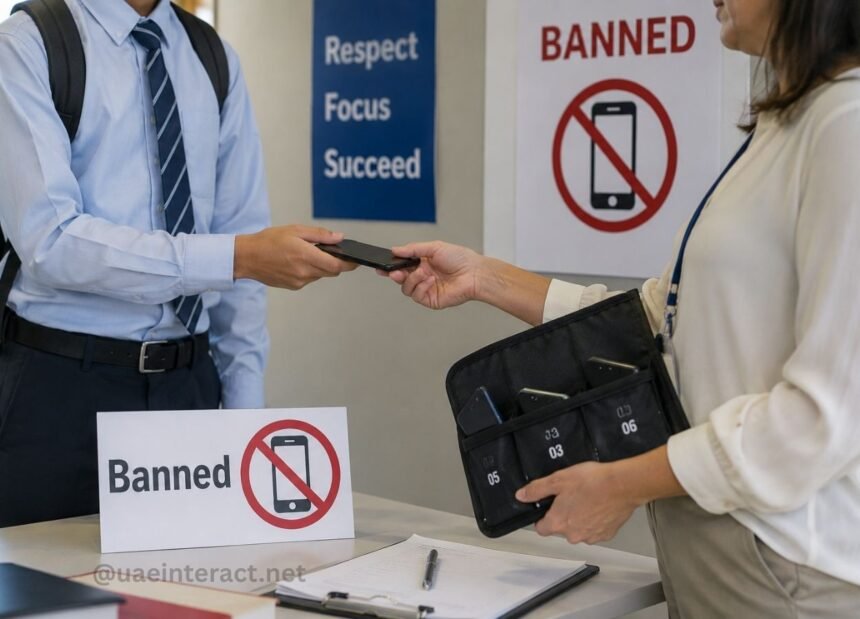
Classrooms across the UAE welcomed students back on Monday. The Ministry of Education has put a restriction on mobile phones.
Schools now pair this rule with lessons on digital habits. Mobile phones are no longer treated as a disciplinary matter.
A directive issued this year by the Ministry of Education bars students, in both public and private schools from carrying mobile phones on campus.
Penalties are attached for those who breach the rule. Because private institutions are not bound by a single uniform approach many have designed their enforcement methods.
These methods range from collecting phones at the school gate to locking them away in secure storage for the day.

Educators say the emphasis this year has shifted toward how the policy is communicated and sustained, not just enforced.
Noufal Ahmed, founder and managing director of Woodlem Education, said clarity and consistent messaging to parents were central to making the rule work, noting that students respond better when they understand its purpose rather than experiencing it as a blanket restriction.
Repeated violations, he added, can lead to a phone being withheld for the remainder of the academic year.
At Diyafah International School in Abu Dhabi, principal Nicole Haynes said the ban was being framed as part of a wider push to support pupils academically and emotionally, stressing that it does not signal a retreat from classroom technology.
The school still runs a Bring Your Own Device programme from Year 3, allowing supervised use of learning devices distinct from personal smartphones.
The renewed attention comes as France’s parliament passed legislation in July restricting social media for under-15s and banning phones in secondary schools, a measure championed by President Emmanuel Macron amid medical concern over screen time’s effect on children.
JSS Private School principal Chitra Sharma pointed to France as a cautionary example, noting that bans falter not over principle but over inadequate storage, staffing and enforcement systems.
She argued genuine progress requires embedding digital wellbeing—covering screen habits, online safety and sleep—into daily school life, rather than relying on a seven-hour ban alone.